 The more I read Luke’s account of our Savior’s conception and birth I learn something new every time. We have become so accustomed to the words over the years that there is a familiarity that paints the picture in monochrome, lacking the vivid color and excitement of an event that would change this world forever. There is so much to be considered here in this story…The census was a pivotal point in the journey of Joseph and Mary to Bethlehem and the census was predominantly for taxation purposes. What is remarkable about this is that this particular one was a part of the documentation that provides the information needed to date this and is from actual census documents written on papyrus and then discovered in the dust-heaps of Egyptian towns and villages and in the sands of the desert. Without going to deep into detail we know there was an actual government edict from Egypt that every man had to go to his own city to be enrolled. This nails down Bethlehem as the place… Now for the trip. Best estimates are that the journey from Nazareth to Bethlehem was eighty miles and accommodation for those who travel was most primitive. Inns at best in that day and time were not very clean and weren’t all that safe. There was no major road that traversed the area that Mary and Joseph would travel and at best they might make about 10 miles a day. Enough said…now to the trip itself.
Sometimes words are just not enough, thus the saying that a “picture is worth a thousand words”….. and since there are no actual pictures from that time we are reduced to just the words. Fortunately we do have written records of that time, and there are biblical archeologists whose studies print a vivid picture in our mind and of course theological based studies of the lives people led in those times. Matthew and Luke were rather sparse in their words used to describe the difficulties and challenges such a trip would present to Joseph and Mary. After a demanding trip to Bethlehem and finding room only in a cave that was being used to stable live stock, what would this trip had been like for Mary and the child in her womb. Most of us have a very firm picture in our minds of what Mary was like. An alabaster complexion, clothed in ornate robes whose hands had never seen a day of ordinary household work. But in reality Mary was an ordinary Palestinian Jewish girl, poor and as we have come to learn of extraordinary faith and abilities. Truth is Mary would have been no different from other Jewish woman of her place and time. Her day would be one of tedious chores and duties to be done, having none of the modern every day technology available to aid her. She would start at sunrise or maybe a bit sooner preparing a meal, then there would be water that needed to be brought in, carried by hand in jars or wine skins. The water would be used for drinking, cleaning, bathing and washing clothes. Ground wheat-flour and other food ingredients had to be gathered and of course firewood to cook with and heat to provide warmth in the cold mornings and evenings. All of these things would require, as some estimate, at least ten hours of work. I think we can say she had to be strong and efficient. Joseph was a carpenter and his day began at sunup and would last till there was no light left to work by. I imagine his face would be of a ruddy complexion, with lines reflecting the responsibility of family and providing for them. His hands would be the rough calloused hands of a working man. He would be a strong and resilient man. Further more it very likely that both Mary and Joseph were, as many of the people of that time illiterate to some degree. Because of where they lived it is possible they had limited knowledge of some Greek and Latin. They most likely lived in a small complex, four small one room houses with dirt floors which were connected by a shared courtyard for cooking and other daily needs. Most of these complexes were shared with kin. It would have been a good thing because the women would be able to help each other with water, wood and other needs. It was not an easy world to live in. They were taxed by both the Temple and the Roman government and people of bad intent were all about them.
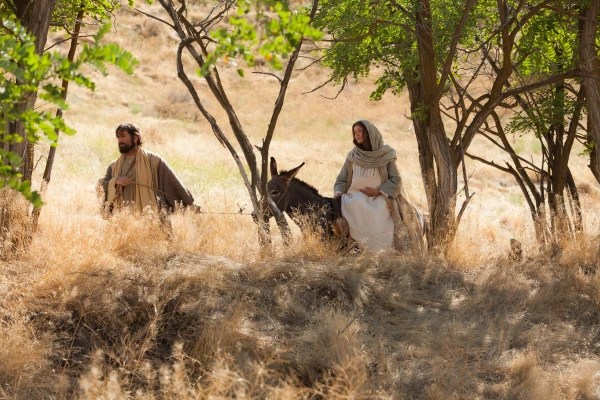
Moving to the journey they were about to make it could not be said that they did not know the dangers of taking such a trip, not to mention that Mary was heavy with child at this time. Mary and Joseph were aware of all the dangers of such a trip. They would have to travel about eighty miles and at best given her condition ten miles a day would be all they really could expect. There would be wild animals, bandits and desert robbers to contend with. Weather would also be a factor as temperatures in winter in this area would be a bone chilling 41 degrees at night and rise into the high forties during the day. I don’t know why but I have always read or been told that the desert temperatures at night felt much colder than you would think. They would have had to have warm clothing, build a fire each night to protect themselves from predators and of course to keep warm as they rested. Their provisions would have consisted of bread, herbs, oil and some dried fish. Water was carried in wineskins. Yet all these things did not intimidate Joseph or Mary.
Some of this may seem redundant but no matter how many times I read or tell the story I always learn something new. In this Advent season we have the opportunity and the time to prepare for this birth of the Christ Child. Joseph and Mary might have had some time themselves but the trip to Bethlehem was not planed at their leisure. It was dangerous and the added burden of Marry’s pregnancy added to the hardships of an unexpected trip at a most inconvenient time. So from that I take this thought…Our faith, our God is not one of convenience, we are called to serve at his pleasure with the assurance that He will provide our needs.
Life is Good
jk
 From The Pew