 This week will bring to a close our dispersal series about the apostles after Pentecost. He became known as Saint James the Great and he was one of Jesus’s 12 apostles, brother of John, the apostle and the son of Zebedee. He was the first of the apostles to be murdered, beheaded by King Agrippa. His death took place in Jerusalem around 44 A.D His body was eventually placed in a tomb in Santiago de Compostela, Spain which became a major pilgrimage site. We know that eventually his identity was known as James the Great and the son of Zebedee and Salome and brother of John the evangelist. He was of course, one of the 12 apostles of Jesus and was part of the inner circle, which also included Peter. Both James and John his brother were referred to by Jesus as the sons of thunder and It was meant to reflect their active zeal in the ministry. As we have mentioned above, he was the first apostle to be martyred, killed by King Herod. James became a Patron Saint of Spain and tradition holds that he preached in Spain, where he is now buried. Taking time to look at his key events in his life. He was called by Jesus while he and his brother were fishing on the sea of Galilee, they both immediately followed him. He was one of the few disciples that Jesus took to witness his transfiguration. After the resurrection of Jesus,James was involved in spreading the gospel and was prominent in the early church in Jerusalem, we find in the book of Acts of the Apostles that King Herod ordered his execution and he became as we have mentioned one of the first apostles to suffer Martyrdom. As we close this one out we add one more interesting fact from gotquestions.org
“The lack of information about James the son of Alphaeus is a lesson in itself. This James was just as much an apostle as were Peter and John. He will sit on a throne in Jesus’ earthly kingdom (Matthew 19:28) with as much authority and honor as the other apostles. His name will be engraved in a foundation of the walls of the New Jerusalem (Revelation 21:14). James will not be considered “less” in eternity because he was faithful to his calling on earth.”
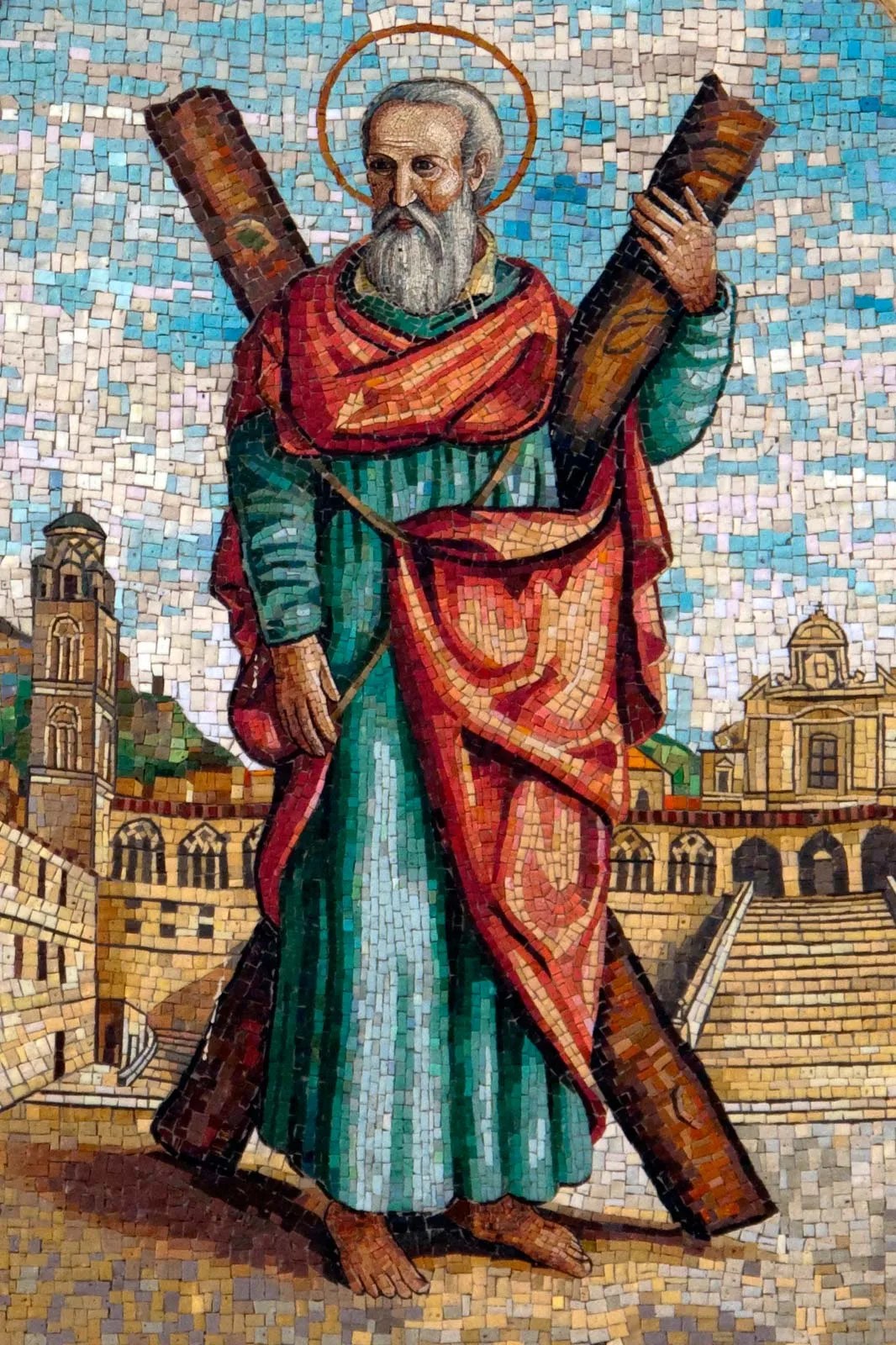
Next, we move to Andrew. Andrew was a disciple of Jesus and he was also Simon Peter’s brother and they were both called at the same time. Just like Peter, Andrew was a fisherman by trade, and he and his brother made a living on the sea of Galilee. They were both from the city of Bethsaida which is located on the North West Coast of Galilee. There’s a neat little memorable twist here to the story. Andrew and John were originally disciples of John the Baptist and they were present when John the Baptist pointed out Jesus as the lamb of God and they followed after Jesus. Jesus noted that Andrew and John had been following him and invited them to spend the day with him and after spending time with Jesus Andrew became convinced that this was the Messiah and he took action. Well, the first thing that Andrew did was to find his brother and tell him we have found the Messiah and he brought him to Jesus. Thus Andrew was one of the first of Jesus’s followers to bring another person to him. In Matthew chapter 4:19 Jesus found Andrew and Peter as they were fishing, casting their nets, and Jesus called to them, “follow me, and I will make you fishers of men.” It is here in this story that we also find an example of what you might say is just all in Christianity, when they were called, they left immediately the family business and everything in order to follow Jesus. Well, it may not be practical in today’s time to do just that many people do, but the example here is not to let anything stand in our way to serve Jesus. One thing about Andrew that is recorded in the Bible is that there was a group of Greeks that approached Philip one of Andrew’s fellow disciples saying they wanted to see Jesus. You can read about that in John chapter 12:20–21. Andrew and Philip together went to Jesus. Two things here, Andrew knew that Jesus would want to see these men, and it can be reasonably assumed that Andrew was one of the very first of the apostles to understand that Jesus had come for all men. The incident with the Greeks, which you can read about in Acts chapter 10:1- 48, anticipates the day when all people will be welcome to come to Jesus.
I hope you have enjoyed this series on “The Few Who Took The Message To The Many.” I hope you will join us next week here in the pew as we continue our mission of taking the message to the many as we look for “The Good Way.”
 From The Pew