
• About

From The Pew

~ A Layman's Look At The Gospel

From The Pew

Author Archives: John Kurt Carpenter

It’s As Simple As XYZ…..?

04 Saturday Aug 2018

Posted by John Kurt Carpenter in Uncategorized

≈ Leave a comment

This is another of those blogs I have started over a number of times. I have spent the week and part of last week reading about church membership, what works and what doesn’t. One thing I discovered from my point of view is a modern-day church quandary. I think that part of the problems of todays’ shrinking membership is because of the fixation on XYZ. Great article by WJSchroer got my attention, very informative and interesting. As I usually do please refer to the link at the end of the blog, good read, seven different generations beginning from 1912 to 2012. My first question, is this a generational thing? Whenever you go searching you will always find things that conflict or muddy the waters so to speak. Now each one of these generations saw a change in direction, expanding or limiting their role in society and changing doing church as we used to. I wondered how involved as a church are we into this generational thing. When we add demographics, PC and local culture the church is hard pressed to find a message that fits its immediate environment without offending someone. Because we are so intent on putting a label on people, placing them conveniently in a box, their humanness becomes secondary to the statistical information many organizations look to for guidance. A good example of this practice can be seen in an article by Jeremy Steele in the United Methodist Communications publication. The article specifically written to a specific population of the church also has a host of turn offs that could put off other generations as well. This is a well written article, informative and except for a few points could be speaking to any of us. Go to the link at the end of the blog. At this point I would add minimizing our humanness to a statistic as a problem for the church.

So what has happened to make this church thing so difficult? People are different and their concept of church does vary as to its importance and place in their lives. The early church was less complicated but far more challenging.  I never really considered the fact that not only do we label people but it seems that we carry that habit over to our church communities. Here are a few of those labels. There is the Institutional Church, the House Church, which really took off in the 70’s and continues even today. Of course we have the Main Line Denominations, followed by the rise of the independent Charismatic churches that have grown in such large numbers. What did the early church worship services look like? Since the first Christian community in Jerusalem was almost exclusively Jewish, it accepted the Old Testament as the Word of God and continued to worship in the Synagogue with the Jews. What distinguished the early Christians from the Jews was their belief that Jesus was the promised Messiah and that salvation was found only in Him. It is within these largely Jewish–Christian Synagogues that the order of worship began to change. They did for a while continue to worship in that Jewish order of worship of Scripture, prayer, the singing of psalms, hymns, and spiritual songs, later adding the Lord’s Supper (cf. Acts 2:42, 46) and prayers in the name of Jesus (cf. Acts 4:24-30). The Christians gathered daily for prayer, fellowship, preaching, and teaching (cf. Acts 2:46; 5:42), They did change from the Jewish Sabbath to the first day of the week almost from the beginning, because it was the day of resurrection. There is a lot of history here and to me while it helps to bring into perspective the churches’ struggle over time with the why, way and how to do church it can become confusing. I take away from the article “WORSHIP IN THE EARLY CHURCH”  by Dr. D. W. Ekstrand that the Synagogue was still in power as a place of worship. Dr. Ekstrand notes:

 “The New Testament refers to it fifty-five times. Our Lord taught in the synagogues of Nazareth and Capernaum; Paul preached in the synagogues of Damascas, Salamis of Cyprus, Pisidian Antioch, Iconium, Philippi, Thessalonica, Berea, Athens, Corinth, and Ephesus.”

There is so much here that I believe I will return to the subject of the early church next week. So far my thoughts are moving toward a rejection of the generational, statistical and PC approach to reaching out to people. I am becoming more scripture conscious and embracing the core values of the faith and not being driven by societal and culture changes. How do we do this in a world that wants to know “what’s in it for me”? Don’t mean to leave you hanging, hoping you will ask yourself, if X,Y, and Z are a bit to simple?

Hope you come back next week…Life is Good

jk

 (http://socialmarketing.org/)

 (http://www.umcom.org/learn/top-10-church-faux-pas-that-turn-off-millennials)

Share this:

  • Tweet
  • Email a link to a friend (Opens in new window) Email
  • Share on Path (Opens in new window) Path
Like Loading...

Pondering Quietly In The Pew……

28 Saturday Jul 2018

Posted by John Kurt Carpenter in Uncategorized

≈ Leave a comment

 Sometimes the silence is deafening and here in the pew it has become to quite. I do believe that as christians we need to express our real sentiments on the subject of religion more often than we do. My dictionary defines religion as “a personal set or institutionalized system of religious attitudes, beliefs, and practices or a cause, principle, or system of beliefs held to with ardor and faith.” Saw a church sign some time ago “you have tried religion, now try Christ.”  Truth is I have always considered religion and faith to be two entirely different things. Continuing the written definition as given are these added points. “ Archaic, scrupulous conformity, conscientiousness to the point of being very careful about doing what you are supposed to do and wishing to do what is right, to do one’s work or duty well and throughly.”   

Religion is ever-changing, evolving and is to some degree shaped by the need to remain relevant to the ever-changing social conscience of society. The church and its desire to stay relevant has given over to a careless practice of inclusiveness. This has promoted a reckless and dangerous acceptance of once questionable behaviors that have challenged our discipline to scripture and God’s will in our lives. To some folks questioning being inclusive is not correct and in some ways stifles the growth of the church. To others the gospel of inclusion is simply the old heresy of universalism. I won’t take up space with the definition of such but you will find it in the dictionary. I try in my writings not to overburden you with scripture, however I do encourage you to know what is contained in God’s word. You must know and believe in your heart having studied, prayed and sought the guidance of the Holy Spirit that which is expected of you for salvation. What? We don’t like being held responsible for our actions but the truth is that in conjunction with salvation is repentance and that friends is scriptural correct. Call it hard-line, unreasonable or old fashion but salvation is offered to all and repentance is expected of all. To repent is to turn from those things that separate us from God. To be a person of the Way we must follow the teachings of Christ. I worry about this silence in the pew. Silence, the complete absence of sound. I would ask, has the need for inclusiveness driven by the need to be relevant brought  acceptance of such behaviors of these days to be the new norm?  Has God rethought this or have we simply rethought the scripture to meet todays changing norms as if it will not affect us or our church. Is the continuing tolerance of abortion simply because we have given it a new definition and it is now not an act that God would find abominable but a right that through its inclusion in the laws of the land is now acceptable? Then there is the same-gender issue that all denominations are struggling with under the banner of inclusiveness. The church becoming involved in social issues that drain its resources and lessen its ability to do the ministry it is called to do. God said we are to be Holy, as He is Holy. How is it that those things which are in conflict with God’s word have now become acceptable under this gospel of inclusion and the re-writing of scripture to fit the ever-growing number of societal changes becoming a daily practice? I just listed two of the many issues that confront Christians today and I did that for a reason.

That old saying between a rock and a hard place could become a Christian mantra if we let it. God, through His Son our Lord and savior has removed the rock but the way is still hard. The message and the forgiveness of sin through the blood of Christ is for all people. There are no prerequisites as to with whom, where or how the message is shared and the old hate the sin and love the sinner does not convey the urgency of salvation and repentance. I believe that God will judge the sin. We are to love the sinner and bring them to the foot of the cross so that they receive salvation and repent of their sin. Sin is anything that separates us from God, not just the two that have become the golden idols on societies altar of causes, we are all sinners.  At the top of todays’ agenda of social change are, abortion which involves the interruption of the process of creation as God intended it to be and the other, same-gender life style is clearly and abomination in God’s eyes.One of the largest denominations in the world lists seven deadly sins that if left unchecked will result in a host of other sins. Proverbs 6: 16-19 lists seven things that are detestable to God. When was the last time you ever heard these addressed from the Pulpit?  The omission of what is sin from the conversation allows for the unacceptable to become acceptable. When I was growing up my parents never said anything about race or the injustice of segregation. The result of which was that the unacceptable became acceptable. The absence of civility in our conversations about the issues of the day seems to me has left only the screamers and agenda driven people at the table. As trite as it may sound 

Matthew 22: 37-40

 ………..’You shall love the Lord your God with all your heart, and with all your soul, and with all your mind.’ 38 This is the greatest and first commandment. 39 And a second is like it: ‘You shall love your neighbor as yourself.’ 40 On these two commandments hang all the law and the prophets.”

The silence in the pew is a reflection of the silence in the Pulpit. Love God first, with all your heart, then you neighbor and do not allow the gospel of inclusion to rewrite the Scripture.

Life is Good

Jk

Share this:

  • Tweet
  • Email a link to a friend (Opens in new window) Email
  • Share on Path (Opens in new window) Path
Like Loading...

The Early Church and Pax Romana

21 Saturday Jul 2018

Posted by John Kurt Carpenter in Uncategorized

≈ Leave a comment

Pax Romana simply means “Peace of Rome” and refers to the tranquility and security that the Roman Empire brought to the Mediterranean world. The Pax Romana lasted from the reign of Caesar Augustus (27 BC–AD 14) to that of Caesar Marcus Aurelius (AD 161–180). At the time of Christ and during the first generation of the church, much of the world was unified under Roman authority and enjoyed a relative peace. (gotquestions.org)

The above is from one of my favorite study sites. Pax Romana, came across it while doing research for another project and wrote it down to come back to later.After reading it again I had an idea that it could plausibly be linked to an often repeated phrase. We often in times of stress and difficult situations will find comfort in saying, God is in control. While we may apply this to these days and times, I believe we often forget that and allow the culture of the day to overpower our faith. This Pax Romana is important to the history of the early church because all of the land surrounding the Mediterranean was at peace because everyone was under Roman Law. So at the time of Christ and during the first generation of the church, the world as understood to be then, was under Roman authority and was pretty much at peace.

While it is perceived that Christians were persecuted for their refusal to worship the emperor that  was not the case. A general dislike or distrust of Christians was most likely due to their refusal to worship the gods or take part in sacrifice, which would be expected from anyone living in the Roman Empire. God could have chosen to spread the gospel in many different ways or forms but He chose ordinary people, empowered by the Spirit to spread the message. So out went the gospel on the feet of spirit led people who had become God’s messengers. Consider if you will these facts.

–Pax Romana provided an environment that allowed safe travel throughout the Roman Empire. 

-Roman discipline cut down on crime on the roads and piracy on the Mediterranean Sea, making travel safer.

These are just a couple of the results of this Pax Romana. A better system of roads over time improved the ease of travel for missionaries, improved business between towns and many Christian business men took the gospel with them on their commercial trips. The largest impact may have been in language. Greek became the common language used throughout the Roman Empire. All throughout the empire people could still communicate with each other, and Paul’s epistles could make their rounds to the churches and be understood by all. It gets even more amazing when you consider that Roman Justice protected Paul many times in his ministry. Pax Romana was really simple. Citizens and residents of the empire, as long as they were not considered a threat to Pax Romana, were quite safe in sharing an unpopular message. We know that over time Paul was accused of disturbing the peace, endangering this Pax Romana but was protected  by the Roman Authorities. All of these things allowed the gospel to spread quickly among those people in the civilized world of Pax Romana. 

Now none of this is to say that God’s people had it easy, we know different. God was in control, God had a plan! Today more than ever we must believe that God has a plan, He is in Control.

Stay the Course

Life is Good 

Jk

Share this:

  • Tweet
  • Email a link to a friend (Opens in new window) Email
  • Share on Path (Opens in new window) Path
Like Loading...

The Argument For Faith ………………is an Argument for Christ

14 Saturday Jul 2018

Posted by John Kurt Carpenter in Uncategorized

≈ Leave a comment

I have written this opening sentence several times and have come to the realization that I might be over thinking this subject a little too much. So to keep it simple here is a fact of life. If your faith is such that it has a heavy influence on your actions, you might be a Christian, a follower of the way or a disciple of Jesus Christ. If this be the case it is inevitable you will be called on to defend the faith. To take this to the next step it is your faith that has placed you in this position and in reality you are defending or better said, presenting “an Argument for Christ.” Peter has set down acceptable ways to enter into this mode of Christian defense. 

1Peter 3:15b-16A

…always be ready to make your defense to anyone who demands from you an accounting for the hope that is in you; 16 yet do it with gentleness and reverence.[c] Keep your conscience clear, so that, when you are maligned, those who abuse you for your good conduct in Christ may be put to shame. 

We must start off being reasonable, which in this present world of discourse is not easily done. It must be inspired by the word of God. It must be an intelligent, clear and applicable statement of position and of divine reasoning. It should contain an element of intelligence that conveys the message that you have prepared yourself through study and prayer to defend your faith; always remembering that you are defending Christ Jesus. This approach requires that you have come by your faith through first hand experience and not another’s story. William Barclay writes,

“It is one of the tragedies of the modern situation that there are so many church members who, if they were asked what they believe, could not tell, and who, if they were asked why they believe it, would be equally helpless. Christians must go through the mental and spiritual effort of thinking out their faith, (Barclay, DBS…1 Peter Pg 266)

Our defense must be given with gentleness. Our attitude must not be one of arrogance. We must not be of  the temperament that those who do not agree with us are stupid or they are unreliable. We must not do as some others with differing opinions and try to shove our beliefs down the throats of those who disagree with us. We must present our Christianity with love and tolerance while maintaining the scripture as written with divine discernment. We must understand that we cannot bully anyone into The Way. We can only lead them to the foot of the cross and allow the Holy Spirit to bring them to Christ. Most any debate today can easily become an argument. There are many debates within and outside of the Christian community that are just a word or two away from becoming an argument. Christians can become engaged in discussions that move to debates and then to full-blown arguments especially concerning theological differences. I wrote earlier that an argument for faith is an argument for  Christ. Any presentation of a case for Christian faith or beliefs must be presented with reverence, the tone and language must be pleasing to God’s ear. There is no room for rancor of any kind. Love for Christ and his love for all people must guide our behavior. As Christians our lives need to be a compelling and a living example that makes it easier for others to believe the message……makes it easier for others to believe in God, Jesus Christ and salvation.

Thanks for coming by, hope to see you in the pew next week.

Life is Good

jk

Share this:

  • Tweet
  • Email a link to a friend (Opens in new window) Email
  • Share on Path (Opens in new window) Path
Like Loading...

And They Will Know….. 1Peter 3:8-15a

07 Saturday Jul 2018

Posted by John Kurt Carpenter in Uncategorized

≈ Leave a comment

You will find that people in the pew have many different opinions but on one thing almost all agree. Folks are tired of the lack of civility, the inability of people to express their differences without disrespect and in many cases these days, out-right displays of hate in words spoken and actions taken. Seriously, we all need to take a step back and see what we are doing to each other and our nation. Of note there is the fact that this type of behavior is not confined to those not in the Christian community.

 John 13:34-35  

A new commandment I give to you, that you love one another, even as I have loved you, that you also love one another. By this all men will know that you are My disciples, if you have love for one another.”

 As shown by these verses There are certain characteristics that make Christians different from others, traits that point to the fact we are his disciples. Here in these verses from 1 Peter are more of those behavior traits that mark a Christian life. Today’s blog looks at  1 Peter 3:8-15a. It would be helpful to read these verses and then return to the blog. 

The Christian community is not immune to the current lack of Civility when addressing different opinions, beliefs or new directions. It seems this type of behavior has found a foothold within our community. Peter gives some great qualities for living a Christian life. He starts with the need for Unity. There are many great passages in the New Testament that encourage unity. We are divided as a community of faith by denominational beliefs, inner-denominational conflicts and in some cases a move to reinterpret scripture to meet the changing societal needs and trends. Even the Apostle Paul pleads for a unity of mind in the church. Throughout the NT there is this plea for unity. To some commentators and bible scholars it is more of a realization that people cannot live a Christian life unless in their personal relationships there is unity and the Church cannot meet its’ Christian call when there are divisions within it. The next being Sympathy. Again we are urged in NT writings to see this as a duty. 

Romans 12:15

15 Rejoice with those who rejoice; mourn with those who mourn.  

Just as evil cannot exist in the presence of our God, neither can selfishness exist where sympathy prevails. With Christ in our hearts sympathy will reign there. From here we move to Love. Peter sets out with what can be literally translated as brotherly love. The love we have for one another and Christian charity for others, all of God’s creation. Here again we see the indisputable fact that love of God requires love of others and also applies to the Church. Neither an individual or the Church can meet the reality of Christianity if they cannot love one another and their neighbors. Peter continues with  a much-needed attribute in this world. Compassion……something we  see less of in this day. In our books, movies, theater, social media and all this world of digital expression allows, we see a disturbing trend of insensitivity to adverse events in our daily lives. There can be no Christianity without compassion. The next attribute. Humility ……… We might measure up well against others but the real test for Christians is…..how well do we measure up to Christ? We know we can never obtain his sinless perfection. We must constantly remind ourselves of our utter dependence on our God. We must strive to be humble in his presence and in the presence of others. The last to share with you would be Forgiveness. We seek God’s forgiveness and it is our calling to extend forgiveness to others.

Ephesians 4:32 

32 and be kind to one another, tender-hearted, forgiving one another, as God in Christ has forgiven you.

 We now go to verse 13 and the remaining verses in today’s scripture. To have written this passage (13-15a) we can tell by his words that although he does not quote directly the OT, it is obvious that his knowledge of it is firmly on his mind. From the very first of these verses Peter insists that you must have a passionate love for Goodness. It is when we seek the goodness of things in this life that the wrong things lose their pull on us. There are some things here that are a part of all people’s lives. Seeking to walk the walk, taking the good way does not exempt us from the human suffering that from time to time comes our way due to circumstances in our lives. Our humanity leaves us open to the trails of life. We can become absorbed with the importance of stuff, money and position. We depend on these things for our comfort and pleasure in this life. This places us in a very vulnerable position, scripture tells us that the things of this life are only temporary. There is then the fact that there can be hardships brought into our lives simply because Jesus Christ holds a unique place in our lives. None of us can escape the sufferings of this life but we as Christians know that suffering for Christ and the faith, it will never touch the things which matter most. 

Thank you for coming by the Pew this week. Next week join me as we lay out an argument for the faith. 

Life is Good

Jk

Share this:

  • Tweet
  • Email a link to a friend (Opens in new window) Email
  • Share on Path (Opens in new window) Path
Like Loading...

Being James… In A Cotton Candy World

30 Saturday Jun 2018

Posted by John Kurt Carpenter in Uncategorized

≈ Leave a comment

Good to be back in the pew and sharing with you. Ah, cotton candy, a familiar sight and part of fairs, circuses, carnivals and Japanese festivals.  Cotton candy (also known as fairy floss in Australia and candy floss in South Africa, the UK, New Zealand and Ireland) is a form of spun sugar. Faith and cotton candy, is not the easiest choice for a blog but interesting and plausible. The process that takes the sugar and small amounts of food coloring to that big mass of joyful fun that disappears in a poof, when placed in your mouth, is simple. The final cotton candy product contains mostly air, with a typical serving weighing around 1 ounce or 30 grams. To me the thing that I noticed first when reading about the process was the use of hot air, turning the sugar to a liquid and then spinning it through small holes where the mixture then solidifies and becomes that magical substance that melts in you mouth. Poof, it is gone! 

It is impossible for most of us to assimilate the events of these days, they happen so fast, encompassing every aspect of our lives. The issues that are driven by an ever-changing culture and the pressures they put on our work, home and family financially and the things we value are at times overwhelming. Life today is kinda like a midway. There are so many things to do, some of value and worth and some are just distractions we escape to for time away from the demands of life itself. There was a time when the church was a constant in an ever-changing world but even the church today is being distracted by the ever-growing glow of the Midway of societal change in values and practices. It could be that I am a bit over zealous here but it seems to me we are turning God’s Word into cotton candy. The word as shared by the church today is much like cotton candy, containing mostly air and when ingested…..Poof, it is gone! 

2 Timothy 3:16-17   (NIV)

16 All Scripture is God-breathed and is useful for teaching, rebuking, correcting and training in righteousness, 17 so that the servant of God[a] may be thoroughly equipped for every good work.

To teaching, rebuking, correcting and training in righteousness, must be added the necessity of preparation for serving God. Unfortunately for many Christians today, It has become a matter of convenience. I wish to be on record that I’m at fault sometimes in regard to that convenience thing and finding fault with others does not help our calling. What might we do instead? Let’s turn to our pew bible and the Book of James, chapter 1, verse 1.

James 1:1 GREETINGS 

James, the slave of God and of the Lord Jesus Christ, sends greetings to the twelve tribes who are scattered throughout the world. 

Following James as an example might be one of  “The Good Ways”  to go. There is a lot of the good way in this first verse. Right off in this verse James makes it plain that the only description of who he is or was, would be to know him as the slave of God and of the Lord Jesus Christ. Quite a tall order in these days. How will people describe us, you and I and the church in conversations around the water cooler. Paul, who holds a place of great respect in the church also referred to himself as a slave but always added and his apostle when writing or introducing himself. 

It is as if James put a period after slave, no need to go any farther. James implies absolute obedience. What does it mean to be a slave? You have no rights of your own; you are the absolute property of your master and unquestioning obedience is required. That definition alone takes us off the midway and sets us down squarely in the reality of service to God, Christ and the Church. James doesn’t stop there. He implies that absolute humility is necessary. In what way? You become a person who thinks of duties not privileges, of obligations not rights. You become someone who places self  last and service to God first. The verse continues on to suggest absolute loyalty. Personal gain or preference should not influence decisions. 

James found his freedom and peace and  glory in perfect submission to the will of God. All of us in this world of cotton candy need to avoid the sugar, hot air and spin that ends in  a Poof……the best we can seek is to be a slave of God,Christ and the Church. 

Life is Good

jk

 Reference Materials     Wikipedia / DBS William Barclay

Share this:

  • Tweet
  • Email a link to a friend (Opens in new window) Email
  • Share on Path (Opens in new window) Path
Like Loading...

Is It Religious Syncretism?

09 Saturday Jun 2018

Posted by John Kurt Carpenter in Uncategorized

≈ Leave a comment

The ever-growing influence of cultural and societal trends, aided by the rapid growth of this digital age often makes life for the church difficult. A new word in the pew at least for me but interestingly informative, Syncretism.  When paired with “Religious” becomes a whole new blog. 

“Religious syncretism, the fusion of diverse religious beliefs and practices. Instances of religious syncretism—as, for example, Gnosticism (a religious dualistic system that incorporated elements from the Oriental mystery religions), Judaism, Christianity, and Greek religious philosophical concepts—were particularly prevalent during the Hellenistic period (c. 300 BC–c. AD 300). The fusion of cultures that was effected by the conquest of Alexander the Great (4th century BC), his successors, and the Roman Empire tended to bring together a variety of religious and philosophical views that resulted in a strong tendency toward religious syncretism. Orthodox Christianity, although influenced by other religions, generally looked negatively upon these syncretistic movements.” 

https://www.britannica.com/topic/religious-syncretism

The church has been subjected for years to a host of new buzz words that often can change direction of thought in a most subtle way. No need to list them but many denominations are affected by their insertion into the conversation. Within the next couple of years there could be a dramatic change in the denominational structure of one of the largest mainline churches. Once again the church has been hijacked by “social warriors” in their quest to achieve their agenda. I must in all fairness disclose that about three years ago I left the Methodist Church because of the reprehensible behavior and disdain for church doctrine and scripture exhibited by the Council of Bishops. Please do not judge me as one of those people who didn’t get their way and “took their ball and went home”. I very much miss the Methodist Church and the Wesleyan way, the church and the people are very much in my heart. It is also necessary to point out that this particular denomination is not the only one struggling with this problem. Truth is that this is not the only problem the “church” universal faces. 

The Word Became Flesh

1 In the beginning was the Word, and the Word was with God, and the Word was God. 2 He was in the beginning with God. 3 All things came into being through him, and without him not one thing came into being. What has come into being 4 in him was life, and the life was the light of all people. 5 The light shines in the darkness, and the darkness did not overcome it.

Truth and power are in the “Word” which is under attack and to be blunt, our Lord and Savior Jesus Christ also. They are trying once again to put Him on the cross, the cross of cultural and societal trends and change. They have failed to learn the “Truth”.

“5 The light shines in the darkness, and the darkness did not overcome it.”  (John 1:5)

This new word “Syncretism” the fusion of diverse religious beliefs and practices, joins that list of buzz words that can change the truth through subtle deception. Religion is the organized way to share the word but it is faith that powers all our efforts through the Holy Spirit and the discernment of the “Truth” as to the will of our Lord. Change in the way we share the word is not a bad thing and in the digital age it is wise to use it to reach as many people as we can. One indisputable fact about the digital age is its ability to influence the thinking of many people without having to establish its validity. “I read that on the internet just the other day.”  So, along with the buzz words, slogans, seminars, leadership failure and the many distractions of the day, I add the word “Syncretism”. It fuses diverse religious beliefs and practices into the Church and they overtime seem as if they have been there forever. They become acceptable because “we have always done it that way.” Syncretism is the chameleon of truth, able to change opinions or behavior according to the situation. We would do well to recall when Pilate asked Jesus “What is truth?”  That was Pilates dubious reply to what Jesus had just said;“I have come into the world, to testify to the truth.” Here from gty.org is a statement that says it best.

 “Others believe truth is a collective judgment, the product of cultural consensus, and still others flatly deny the concept of truth altogether.”

Amen and a resounding  yes to that! The author of that article also offers this thought.

 Here’s a simple definition drawn from what the Bible teaches: “Truth is that which is consistent with the mind, will, character, glory, and being of God.” 

If we change what is biblical truth to accommodate the consensus of cultural change, it will in time work its way into the church. It will become a Syncretism, one of those “always done it that way things.”

 Go to the link below to read the entire article.

https://www.gty.org/library/articles/A379/what-is-truth

Sin is sin and there are many of such that separate us from our God. It is important that we remember:

5 The light shines in the darkness, and the darkness did not overcome it.

We must not be the generation that let the “light” be overcome. 

This will be the last blog this month due to medical issues which must be attended to. We will publish our next blog on July 1.

God Bless …… Life is Good

Jk

Share this:

  • Tweet
  • Email a link to a friend (Opens in new window) Email
  • Share on Path (Opens in new window) Path
Like Loading...

Does God Hate?

02 Saturday Jun 2018

Posted by John Kurt Carpenter in Uncategorized

≈ Leave a comment


We can’t escape the fact that as a nation we seemed to have evolved into a society that has embraced “hate”as a means of disagreeing with others. Hate seems to lift us to new heights of deplorable behavior, in which reason or compassion is lacking for those who become the target of such behavior and society seems to enjoy minimizing the value and worth of others or  to put it another way, enjoying another’s misery  has become a national pastime.  In the last few months it seems we have sunk to a new low. Some characteristics of this type of behavior, would be to loathe, detest, despise, dislike, abhor, feel intense or passionate dislike for someone. I think we could agree that “hate” is a time-consuming behavior. Now let’s be honest. There are things that we all find more than just annoying. You might hate flying, eating alone, even hate having to engage in conversation with certain people, or even hate having to admit you are uncomfortable in certain situations, all normal feelings. What today’s blog is looking at would be the type of hate that drives people to deliberately seek ways to do and say things that demean and hurt others simply to cause hurt and advance their agenda, because of their consuming hatred for others. This type of behavior becomes a weapon for those who are unable to express their dislike through reasonable discourse. Jesus himself was subjected to ridicule by those who despised him, or in some cases hated him.  

 Mark 3: 20-22

Then he went home; 20 and the crowd came together again, so that they could not even eat. 21 When his family heard it, they went out to restrain him, for people were saying, “He has gone out of his mind.” 22 And the scribes who came down from Jerusalem said, “He has Beelzebul, and by the ruler of the demons he casts out demons.”

 The Jewish elders and ruling class accused him of being a heretic, even though many of his answers to their questions were based on his knowledge of  the scripture and echoed their views. Truth or reason were not present, they were destroyed or put aside by hate.

Last week we took a look at the difference between secular and biblical justice and the cultural influence today in light of the heightened interest in “social justice”. Today we look at “hate”. Could there be a God-like hate?  God hates….  just writing that does not seem right.    1John 4:8 Anyone who does not love does not know God, because God is love. 

 It is God’s nature to love, to do what is best for us, his people. It is only natural that He would hate that which is contrary to his nature. Just as we hate those things that destroy what we love, God hates those things that destroy what he loves and has created. We have been created with the ability to hate as well as love but for many of us today it seems as if hate has become a motivating factor. So let’s look at hate in the secular state versus God’s hatred. The bible teaches us that the object of God’s hate is sin and wickedness. Viewing the world we have today that must be a long list. I want to keep this simple and to the point. In doing so I may be misunderstood, but the answer to the question “does God hate?” The answer is yes.  

Psalm 5:4-6

 4  For you are not a God who delights in wickedness; evil may not dwell with you. 5 The boastful shall not stand before your eyes;you hate all evildoers. 6  You destroy those who speak lies; the Lord abhors the bloodthirsty and deceitful man.

Psalm 11:5

5  The Lord tests the righteous, but his soul hates the wicked and the one who loves violence.

Proverbs 6:16-19

16  There are six things that the Lord hates, seven that are an abomination to him: 17  haughty eyes, a lying tongue, and hands that shed innocent blood, 18  a heart that devises wicked plans, feet that make haste to run to evil, 19  a false witness who breathes out lies,…

It is something we all have a problem with, we do overlook the fact that the God we serve can and is capable of such an emotion…. “hate” is just not an everyday thing we associate with our God. No need to drag this out. Secular hate is designed to hurt, destroy and degrade and it has no redeeming value. These two quotes from are from  “Got Questions”.

 “When the Bible does speak of God’s hatred, the object of His hatred is sin and wickedness.”  

The righteous and the wicked make different choices and have different destinies—one will see the ultimate expression of God’s love, and the other will know the ultimate expression of God’s hatred.

What is your choice this day? Will you join the chorus of those driven by hate, using cruel, hurting words to inflict pain and discredit others simply because you don’t agree with their views. Secular hate is directed toward the individual, while God’s hate is on sin and wickedness, which when reputed and repentance sought, leads to salvation.

Life is Good

jk


Reference  https://www.gotquestions.org/does-God-hate.html


Share this:

  • Tweet
  • Email a link to a friend (Opens in new window) Email
  • Share on Path (Opens in new window) Path
Like Loading...

The Bible, Starbucks and Social Justice……Mob Style

26 Saturday May 2018

Posted by John Kurt Carpenter in Uncategorized

≈ Leave a comment

Starbucks has become over the years a trendsetter in the ever evolving world of social justice, often challenging the socially accepted norms of behavior.  Social justice and understanding it’s meaning in today’s world is necessary to navigate successfully through its ever-changing expectations. What exactly is social justice? Social justice is a concept of fair and just relations between the individual and society. This is measured by the explicit and tacit terms for the distribution of wealth, opportunities for personal activity and social privileges. (Wikipedia) The Definition of social justice is  a state or doctrine of egalitarianism, which is the doctrine that all people are equal and deserve equal rights and opportunities. I find the stark differences between the Bible and the secular view of social justice interesting. The simple way to look at this is that social justice in the secular world has become a “ME” thing, while from a Bible perspective  it is about God’s people. The people whom society has pushed to the fringe, unable to speak, defend or care for themselves. I admit this to be a fine line but to me social justice is not about privileges or supposed rights. I take the Christian view….it is about respect, love, and caring for God’s people, as we are commanded. This brings me to an excellent article by Jack Wellman. He shares a series of scripture verses which provide, in my opinion a biblical basis of social justice. I recommend that you go to the link provided at the end of the blog.

I would like to share a few of them from the article with you.

-Isaiah 1:17 “Learn to do good; seek justice, correct oppression; bring justice to the fatherless, plead the widow’s cause.”

Perhaps as we let the “ME” thing define our social justice thing we overlook the obvious. James also gives us reason to examine our actions. James 1:27  Pure and undefiled religion in the sight of our God and Father is this: to visit orphans and widows in their distress, and to keep oneself unstained by the world.

–Zechariah 7:9-10 “Thus says the Lord of hosts, Render true judgments, show kindness and mercy to one another, do not oppress the widow, the fatherless, the sojourner, or the poor, and let none of you devise evil against another in your heart.”

Mr. Wellman writes that there are lots of areas of neglect in our nation, there is no excuse for the church to be part of it.

-Proverb 31:8-9 “Open your mouth for the mute, for the rights of all who are destitute. Open your mouth, judge righteously, defend the rights of the poor and needy.”

Please take a moment at the end of this blog to read Mr. Wellman’s comment on the above verse.

-Micah 6:8 “He has told you, O man, what is good; and what does the LORD require of you but to do justice, and to love kindness, and to walk humbly with your God?”

We have been told what is good. Why do we not do it?

-Psalm 82:3 “Give justice to the weak and the fatherless; maintain the right of the afflicted and the destitute.”

-Matthew 7:12 “So whatever you wish that others would do to you, do also to them, for this is the Law and the Prophets.”

To use a term from another writer the “Social Warriors” have taken over and most often their motivation is a “ME” thing. The above scriptures plainly point to who, what, how we should respond. Allow me to repeat.. “The simple way to look at this is that social justice in the secular world has become a ME thing, while from a Bible perspective it is about God’s people.” This cuts a fine line for there are many opinions. Who are God’s people? 

I believe that we are all created by God and God loves all people, thus he is concerned about them, all of them. The term God’s People usually indicates a clear relationship with the Father and Jesus Christ. I will leave the definition of relationship to you. I see here another hijacking of the gospel being interwoven with a social issue and becoming the property of a mob of “social justice warriors.” The biblical view of social justice is not about privileges or supposed rights, it is about respect, love, and caring for God’s people, as we are commanded to do.The “ME’s” of this world won’t get it done. You cannot legislate compassion, you will not right an injustice through the pressure of  a “mob” with an agenda. There is a biblical justice that comes from our God, lives in our hearts and needs no agenda to dictate its actions. It is very simple.

“But if anyone has the world’s goods and sees his brother in need, yet closes his heart against him, how does God’s love abide in him? Little children, let us not love in word or talk but in deed and in truth” (1st John 3:17-18).

Thanks for coming by this week. Thanks to Jack Wellman for the sharing through his article the other side of “social justice”. Be sure to follow his link listed below.

Life is Good

jk

Jack Wellman is Pastor of the Mulvane Brethren Church in Mulvane Kansas. Jack is also the Senior Writer at What Christians Want To Know whose mission is to equip, encourage, and energize Christians and to address questions about the believer’s daily walk with God and the Bible. You can follow Jack on Google Plus or check out his book Teaching Children the Gospel available on Amazon.

http://www.patheos.com/blogs/christiancrier/2016/09/30/7-bible-verses-about-social-justice/


http://www.patheos.com/blogs/christiancrier/2016/09/30/7-bible-verses-about-social-justice/


Share this:

  • Tweet
  • Email a link to a friend (Opens in new window) Email
  • Share on Path (Opens in new window) Path
Like Loading...

Tacky……

19 Saturday May 2018

Posted by John Kurt Carpenter in Uncategorized

≈ Leave a comment


After a spiritual experience at a German prayer meeting on Aldersgate Street in London on May 24, 1738, John Wesley was not welcomed to preach in most of the churches in London. The message that we are saved by faith, not good works was not welcomed or accepted by the other pastors in London. A friend, Whitefield was preaching in the fields at Bristol but Wesley was reluctant to preach outdoors. He thought it was tacky! He accepted Whitefield’s invitation to “come and see” and went to that field in Bristol, and was so impressed he agreed to preach there the next Sunday. Wesley was moved by what he saw God doing in the lives of these poor, simple people who were not welcome in the local churches. 3000 people, on a hillside with an old pulpit set in the grass and dirt, suddenly, Tacky didn’t apply. Wesley, a High-Church minister, was about to receive a revelation!  3,000 poor and ordinary people on a hillside, not church goers, who listened to the word of God’s love and transforming power. We always remember the sermon on the mount and Jesus speaking to a multitude of people who continued to gather even as he spoke. Throughout the Bible God’s word was preached and the good news shared with all people in all places, the venue was never the determining factor. There was a time as the good news went out that people would meet in caves or a home due to the persecution of those who had become known as “people of the way”.  Where there were no established meeting places people would gather outside the cities in small groups. “Where one or more are gathered in my name….” The people wanted to hear the word, location and comfort were not considered.

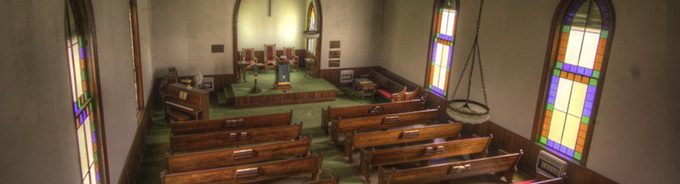
Recently the church board decided that it might be time to look at our sanctuary and consider a renovation. Of course leading up to the final vote of approval have been discussions about, cost, physical changes, time will start and of course time it will be completed. Here in these discussions lie the heart of the matter. More and more churches are replacing pews with chairs, this can become an issue along with colors, carpet, church furniture, placement of pulpit, lectern, altar, music and of course tradition:

 “a way of thinking, behaving, or doing something that has been used by the people in a particular group, family, society, etc., for a long time”

I have really had no firm position on Chairs or Pews but like many church folks I have a vision of what a sanctuary looks like from years of repetitive Sunday worship services. Now I am being asked to select one or the other. After some research
I decided it did not matter that much. I came to the conclusion that standing in a field, sitting on a hillside or benches on a dirt floor does not hinder the word being heard or praise being lifted up. In all these places we can find our Lord and Savior, Jesus Christ. I would not call that Tacky. Either way, come and see. You will find me about nine pews or row of chairs from the front. If I still can’t make my mind up, I’ll be sitting in the floor in the back. Thanks for coming by today.

Life is Good

jk

Share this:

  • Tweet
  • Email a link to a friend (Opens in new window) Email
  • Share on Path (Opens in new window) Path
Like Loading...
← Older posts
Newer posts →

Recent Posts

  • The Light That Leads To The… Good Way
  • Back Porch
  • Before The Good Way… Leviticus
  • Back Porch
  • The Good Way…Proverbs 3 Wisdom, Love, Humility, and Fear.

Archives

  • January 2026
  • December 2025
  • November 2025
  • October 2025
  • September 2025
  • August 2025
  • July 2025
  • June 2025
  • May 2025
  • April 2025
  • March 2025
  • February 2025
  • January 2025
  • December 2024
  • November 2024
  • October 2024
  • September 2024
  • August 2024
  • July 2024
  • June 2024
  • May 2024
  • April 2024
  • March 2024
  • February 2024
  • January 2024
  • December 2023
  • November 2023
  • October 2023
  • September 2023
  • August 2023
  • July 2023
  • June 2023
  • May 2023
  • April 2023
  • March 2023
  • February 2023
  • January 2023
  • December 2022
  • November 2022
  • October 2022
  • September 2022
  • August 2022
  • July 2022
  • June 2022
  • May 2022
  • April 2022
  • March 2022
  • February 2022
  • January 2022
  • December 2021
  • November 2021
  • October 2021
  • September 2021
  • August 2021
  • July 2021
  • June 2021
  • May 2021
  • April 2021
  • March 2021
  • February 2021
  • January 2021
  • December 2020
  • November 2020
  • October 2020
  • September 2020
  • August 2020
  • July 2020
  • June 2020
  • May 2020
  • April 2020
  • March 2020
  • February 2020
  • January 2020
  • December 2019
  • November 2019
  • October 2019
  • September 2019
  • August 2019
  • July 2019
  • June 2019
  • May 2019
  • April 2019
  • March 2019
  • February 2019
  • January 2019
  • December 2018
  • November 2018
  • October 2018
  • September 2018
  • August 2018
  • July 2018
  • June 2018
  • May 2018
  • April 2018
  • March 2018
  • February 2018
  • January 2018
  • December 2017
  • November 2017
  • October 2017
  • September 2017
  • August 2017
  • July 2017
  • June 2017
  • May 2017
  • April 2017
  • March 2017
  • February 2017
  • January 2017
  • December 2016
  • November 2016
  • October 2016
  • September 2016
  • August 2016
  • July 2016
  • June 2016
  • May 2016
  • April 2016
  • December 2015
  • August 2015
  • June 2015
  • May 2015
  • April 2015
  • March 2015
  • February 2015
  • January 2015
  • December 2014
  • April 2014
  • January 2014
  • December 2013
  • November 2013
  • May 2013
  • March 2013
  • February 2013

Categories

  • Uncategorized

Meta

  • Create account
  • Log in
  • Entries feed
  • Comments feed
  • WordPress.com

Blog at WordPress.com.

  • Subscribe Subscribed
    • From The Pew
    • Already have a WordPress.com account? Log in now.
    • From The Pew
    • Subscribe Subscribed
    • Sign up
    • Log in
    • Report this content
    • View site in Reader
    • Manage subscriptions
    • Collapse this bar
 

Loading Comments...
 

    %d