
An Old Man’s Lament…


For a large number of Christians, Christmas is the celebration of the birth of Christ, God’s gift of salvation and the path to the restoration of his relationship with his people. The story is remarkable, a virgin gives birth to a boy in a stable who is in reality the Son of the Living God. A star marks the manger where he lay, Angles sing of his birth, shepherds follow the star to see this Child. It is not long thereafter that wise men seek him also, bringing gifts. This child will bring about the wholesale murder of all boys born that day and he will become the subject of a massive manhunt…he has yet to utter a word. We know little of his early life and in later years he appears before a rather strange man in animal skins who lives on bugs, nuts and berries and is at home in the desert wearing animal skins, pleading for people to renounce their sins because the Messiah is soon to come. A remarkable story whose reality is even more remarkable. From these humble beginnings the Greatest Story Ever Told is born. Consider this…there were from the beginning doubters and history has put forth many arguments and theories about this man who presented himself as the Messiah. There is the fact that the Jewish people had always expected a savior, the one who would restore Israel to her rightful place as the chosen people of God. 

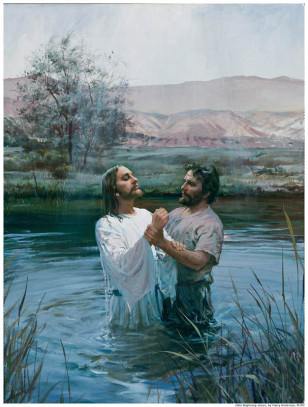
From the early prophets to that very day of his baptism by John in the wilderness, the Jews had lived with this in-destructible faith and the raw belief that it would be so. The beginning of the ministry occurred with his baptism in the countryside of Roman Judea and Transjordan, near the River Jordan by John the Baptist. New Testament writings give as the principal locations for the ministry of Jesus as Galilee and Judea, with activities also taking place in surrounding areas such as Perea and Samaria. 

Now I need to be careful here but the enormity of the scope of his ministry is pivotal to the story. Three years a total estimated distance of 3,125 miles, Jesus WALKED during his ministry. Add to that his disciples, the 12 of his picking, walked with him…most likely the majority of those miles. Now there are records of large crowds following him through certain areas and there were others we find in the gospel writings that were with him at various times… I think of it sometimes as being a traveling caravan of Salvation…with the Cross going on before. I believe Jesus saw that Cross on the horizon when he took his very first step on those roads. He would sit among the mighty and the fallen, kneel in the dust of a town to speak to the stoning of a woman, speak to a Samaritan woman at a well, heal the blind and sick on the Sabbath…all these acts adding to his notoriety and adding fuel to those enemies that would have him put aside. His ministry would come to an end on the ragged outcrop of a hill…There he would be taunted, mocked and nailed to a wooden cross, his side pierced just as the heavens open up in fury and the cloth rent…. The world would never be the same. 

 I have thought of many ways to bring this blog to a close. I then realized the story is not finished yet, the end is yet to come. The brightness of the lights, the joy of the tree and the unexpected love we feel for people in general makes me wish everyday could be Christmas. God has blessed the world with the greatest gift ever given to man. It is argued every year to keep Christ in Christmas. I encourage you to not pack him away till next year….Keep him in your heart, mind and very being…. The story is not completed yet. 

Come Lord Jesus

Life is Good

jk


Drop The Blanket

This is a repost from a few years ago…It has become a tradition to post it each year at at Christmas. May you and yours have a Merry Christmas…Praise God for his son Jesus Christ!

I am constantly searching the internet for little gems of knowledge and wisdom that will enrich and encourage us ordinary folks whose frantic pace in this life causes us to rush by without even taking the time to “smell the coffee” so to speak. Well over fifty years ago we were introduced to the world of Charlie Brown. Charles Schultz created a community of loveable misfits each with their own recognizable frailties’ of mind, body and spirit, in which many of us saw a part of ourselves in the characters and took this lovable bunch into our hearts. Unlike some of the modern animated cartoons of this day the brilliance of Charles Shultz shows us our faults in a gentle and endearing way. Charlie Brown also helps us see the real value of community, the need we have for others and the power of a simple love that transcends the norms of this day. Having said all this let me introduce you to a brilliant post of December 14, 2014, by Jason Soroski. I have edited his original post for space requirements and encourage you to go to the posted url to read it as posted. (jasonsoroski.wordpress.com)

Here are some excerpts from that post.

I was in the first grade back when they still performed Christmas pageants in schools (less than 50 years, but still a very long time ago), and our class performed a version of the Charlie Brown Christmas. Since I was kind of a bookworm and already had a blue blanket, I was chosen to play the part of Linus. As Linus, I memorized Luke 2:8-14, and that Scripture has been hidden in my heart ever since. But while working so diligently to learn those lines, there is one important thing I didn’t notice then, and didn’t notice until now. Right in the middle of speaking, Linus drops the blanket.

Throughout the story of Peanuts, Lucy, Snoopy, Sally and others all work to no avail to separate Linus from his blanket. And even though his security blanket remains a major source of ridicule for the otherwise mature and thoughtful Linus, he simply refuses to give it up. Until this moment. When he simply drops it. In that climactic scene when Linus shares “what Christmas is all about,” he drops his security blanket, and I am now convinced that this is intentional. Most telling is the specific moment he drops it: when he utters the words, “fear not”

 Looking at it now, it is pretty clear what Charles Schultz was saying, and it’s so simple it’s brilliant.

The birth of Jesus separates us from our fears.

The birth of Jesus frees us from the habits we are unable (or unwilling) to break ourselves.

The birth of Jesus allows us to simply drop the false security we have been grasping so tightly, and learn to trust and cling to Him instead.

I hope you have enjoyed this post and take Jason Soroski’s advice and “drop the blanket” in the coming new year. Again I encourage you to go to the url posted above and read some more of this gentlemen’s writings and activities.

Life is Good

jk


Back In The Day…The World Into Which He Came

This time of the year is always busy and is a time of celebration as we prepare for the birth of the Christ child. It is also a time in which the secular world is full of frustration, uncertainty and in need of divine intervention.   Thousands of years ago a divine intervention came about…God sent his Son…Jesus Christ as an instrument of salvation and restoration, an instrument of reconciliation between God and his people. What kind of world was he born into?

 When Jesus was born all of Jewish Palestine and some of the neighboring Gentile areas were ruled by Rome’s friend an ally Herod the Great. He was appointed By Rome to be the King of Judea. He built many fortresses, aqueducts, theaters, and other public buildings. He was known for having raised the prosperity of his land. In New Testament writings he is portrayed as a tyrant, into whose kingdom Jesus of Nazareth was born. Palestine lay between Syria and Egypt which were two of Romes most valuable possessions. Herod was allowed to remain King as long as he maintained the requirements of stability and loyalty demanded by Rome and granted him pretty much a free hand in his governing his kingdom. Herod died shortly after Jesus was born. The kingdom was divided into five parts. The Gentile areas were separated from the Jewish areas, which were spilt between two of Herod’s sons.  There is much more information concerning the politics of the day but we will simply focus on just those in the area of Jesus’ birth that affected his  future ministry. Over time and in the time of Christ’s ministry Augustus disposed of Archelaus and transformed Judaea, Idumaea, and Samaria from a client kingdom into an “imperial province.” A minor Roman aristocrat later referred to as a procurator was sent to govern and protect Rome’s interest. During Jesus’ public career, the Roman Prefect was Pontius Pilate (ruled 26–36 CE).

Now normally the area of Judaea, Samaria and Idumaea, was govern directly by the Prefect, but in this instance the Perfect relied on local leaders. He was supported by a small Roman army numbering about 3,000 men and they came from the mostly Gentile cities of Caesarea and Sebaste. Most of the officers for this force came from Italy and if needed in Jerusalem this force could be there in two days. I am going to passover a large part of the organization of the government and go straight to the way it was in the Lord’s Day.

At the time of Jesus’ public career, Galilee was governed by the tetrarch Antipas, Judaea (including Jerusalem) was nominally governed by Pilate, but the actual daily rule of Jerusalem was in the hands of Caiaphas and his council. 

( Caiaphas served as the Jewish high priest in the Jerusalem temple and president of the Sanhedrin at the time of Jesus Christ’s death. Caiaphas accused Jesus of blasphemy, which led to his death sentence by crucifixion.)

It was a strange partnership the truth being that the Romans wanted to protect their investment and the Jews wished to protect the Temple and rule over their people. Just as the Romans would not tolerate disorder and non-compliance with Roman law, the Sanhedrin, the highest Jewish court of justice and the supreme council in ancient Jerusalem were protective of their power and the beliefs of the faith. The Jews had been waiting for the coming of their Messiah…he who would free them now from the harsh rule of the Romans. As the folks used to say “there ain’t no sense plowing old ground.” The world into which he came was a cruel and harsh one. There were those who had much and those who had little or nothing. There was no in-between. That’s about as simple as I can tell it.

It has been interesting taking time to consider some of the back stories of those bible stories that we read every year at this time. Two weeks ago as I wrote….

That Star has lost some of its glow. The scripture in   2nd chapter of Luke is one we have read every year and behind those words lie the rest of the story. 

 Behind those words that came from a couple of weeks ago comes the realization that we are still struggling with greed, anger and hate for other people. But consider this…That Star is still there and so is our Lord and Savior.We must put aside those things that separate us from our God and let the STAR glow bright in our world today. Next week will be our annual Christmas post…Charlie Brown will be back.

Life is Good… May you find abundance, kindness and love…That Star is still with us and our Savior Christ is among us this very day.

jk

His Name Is John…Luke 1:57-66

In the previous verses we read of Mary going out into the hill country to a city of Judah, where she went into the house of Zacharias and greeted Elizabeth who was aware that Mary was with child. In these next verses we meet Elizabeth’s child John, soon to be born and will become  known as John the Baptizer, this child was to do great things, a special child, already posing the question among all the neighbors …’What will this child turn out to be, for the hand of the Lord is with him?’ Here Jewish tradition and law enter the story…

In Palestine the birth of a boy was an occasion of great joy. Add to this the fact that Elizabeth, already considered to be past the age of conceiving has been delivered of a boy child, the musicians and all those gathered there broke into song, congratulations and rejoicing. Elizabeth now had the child she and Zacharias had prayed so long for…a boy, it was truly a double blessing and double joy. Jewish law required that a male child be circumcised on the eighth day and be given a name. In Palestine names were descriptive. Elizabeth surprised her neighbors and friends by insisting that her son must be called John, to which Zacharias  also agreed. This was the name God instructed be given the child, as it means Yahweh’s gift or God is gracious. It pointed to the parents gratitude and unexpected joy. For all those who had heard the amazing story of how God had blessed the parents and honored their prayers, there was the inevitable question…‘What will this child turn out to be?’ 

Zacharias had high hopes for his son. He envisioned him to be a prophet and the forerunner who would prepare the way of the Lord. The Messiah, God’s anointed king, a day and time every Jew hoped and longed for would come soon. Zacharias considered his son to be the one who would prepare the way for the coming of God’s king. He would the one who would baptize the people, preparing them for the coming of the Son of God, the Messiah.

Zacharias, speaking of his son gives us a picture of what this preparation will consist of.

 Luke 1:75-77

75 in holiness and righteousness

    before him all our days.

76 

And you, child, will be called the prophet of the Most High;

    for you will go before the Lord to prepare his ways,

77 

to give knowledge of salvation to his people

    by the forgiveness of their sins.

-We should live our lives in preparation for the Lord’s coming.

-There will be a knowledge of what God is really like when the Messiah comes.

-There will be forgiveness and the restoration of our relationship with God.

-With Christ we are enabled to walk in the ways that lead to everything that means life, and no longer to all that means death. 

We often pass by John the gift that is hid behind the greatest gift, the coming of God’s son and the mending of the relationship between God and his people. The Greatest Story Ever Told…ushered in by angels on high and a strange man in animal skins… 

John The Baptist.

Life is Good

jk

1000 Words…Tis’ The Season…..


 “From The Pew” 2018.  This Blog was posted three years ago…


 The painting to the left is a work by the artist Sigismund Christian Hubert Goetze. It has been said that a picture is worth a thousand words but if you look closely you will  realize the impossibility of giving even a faint idea of its power and awful significance with words from a people who refuse  to recognize their Savior. 

This is traditionally a time that we prepare to celebrate the birth of Christ. It is the time of the Angels singing on high and joy and goodwill to all mankind. Trees are going up and strings of colored lights decorate our homes and even our cities! Children’s faces are aglow with anticipation of Santa, gifts under the tree  and there seems so little time to get everything done. The shopping malls will soon be full of shoppers, pushing, rushing from one store to another and if you look carefully there are few smiles of joy. For many the pressures of the season overwhelm them. In the city where I live there are a number of homeless encampments within hearing distance of the canned Christmas music that is being played everywhere. There will be the usual laments about Christ being taken out of Christmas even though the facts are plain, Christmas is a Christian thing celebrating the birth of Christ. That being said it is worth noting  “Many popular customs associated with Christmas developed independently of the commemoration of Jesus’ birth, with certain elements having origins in pre-Christian festivals that were celebrated around the winter solstice by pagan populations who were later converted to Christianity.”  As we make our way back to the painting I must share with you this scripture from   Isaiah 53: 3-5….


He was despised and rejected by others;

    a man of suffering and acquainted with infirmity;

and as one from whom others hide their faces

    he was despised, and we held him of no account

This chapter foretells the sufferings of the Messiah, the reason he did so and for which he died. The Jews were not impressed by this poorly dressed man and his humble appearance and manners. He would suffer for sins not his own, giving to us the gift of salvation. When you can, please read Isaiah 53: 1-11.    

According to an article on the painting in The Literary Digest, “‘At the exhibition of the Royal Academy in London, the great canvas by Sigismund Goetze … has created an artistic sensation.’ It is declared to be a ‘powerful and terribly realistic presentment of Christ’ in a modern setting.”

Overwhelmed by the season we are unable to see the real gift, the good news if you will, hidden amongst bright-colored ribbons and Christmas wrappings of red and green, mankind’s  only hope for redemption and salvation. The painting of course goes past that to the end result. Why in this time of celebration and great joy would I take us there? Simply put, we have the book, the word and yet we are the mirror image of the people in that painting. Going about our business, caught up in our importance, so rushed with life we can only spare a couple of hours out of this season to note the gift of our salvation coming among us. There among a heedless crowd, bound by ropes upon a pedestal stands the Christ. Do our actions say “it is nothing to me”?

To Christians Christmas is not a season, it is the presentation of the gift of the Father to his children in the person of the Christ child, a promise of hope, life and goodwill to all men.

Life is Good

jk


Luke 2…and Thanksgiving

Luke was what we would call a people person and a gatherer of information and was one of Paul’s companions. Luke was always a writer of fact, meticulous in detail and accurate to a fault. For this reason These verses we look closely at today are special.

Luke 2:25-35

The Jews had always regarded themselves as the chosen people and nation of God, so destined to attain greatness in this world but to their credit they knew this destiny could never be by human means. There were other means that would bring this about and there was one among the many who quietly waited with prayers patiently waiting with humble expectations, they waited for the day God would confront his people.

There was a man in Jerusalem named Simeon, who all knew to be a good and pious man. Generations of God’s people had waited for the Messiah, the Savior to bring consolation or comfort to the nation of Israel. The people had faith he would come and deliver them once again just as he had done in the past…Out of Egypt and slavery. Simeon too knew he would come because he had received the promise from the Holy Spirit and on that day he was led to the Temple. One of the things that I have learned from studying over the years is that Jewish tradition will prevail in most all situations and at this point of the story it does not disappoint. Joseph and Mary, in faithfulness to the Law, traveled to Jerusalem while Jesus was still an infant to present Him to God in the temple and at this time the promise to Simeon was granted. Simeon knew the baby Jesus instantly and as he picked him up in his arms…these words rushed from his mouth… 

“Sovereign Lord, as you have promised,

you may now dismiss your servant in peace.

For my eyes have seen your salvation,

which you have prepared in the sight of all nations:

a light for revelation to the Gentiles,

and the glory of your people Israel” (Luke 2:29–32).


Luke 2:49-52

49 “Why were you searching for me?” he asked. “Didn’t you know I had to be in my Father’s house?”[f] 50 But they did not understand what he was saying to them.51 Then he went down to Nazareth with them and was obedient to them. But his mother treasured all these things in her heart. 52 And Jesus grew in wisdom and stature, and in favor with God and man. NRSV

In these verses we see how Jewish Tradition once again becomes a determining factor in our story. Tradition required that every adult male Jew within fifteen miles of Jerusalem must attend the Passover. It was in fact a goal of every Jew in the world to attend the Passover at least once in their lifetime. There was the Tradition also that every male Jew when they became twelve years of age become a son of the law and take obligations of the law upon themselves. This trip, the holy city and the Temple and the sacred ritual had a huge impact on Jesus. At the close of the festival as people set out for home Jesus stayed behind, his parents were not aware of this, not to be attributed to carelessness on their part. It was the customs of those traveling to do so in groups as a protection against the hazards of the road both natural and otherwise. The women would always leave a bit earlier than the men because they traveled at a slower pace. The men traveling at a faster pace would catch up with the women and children about the time the evening encampment was reached. Jesus was now 12 years old and by Jewish tradition a man. In this time of excitement both Mary and Joseph believed he was with the other group. They missed him soon after the groups came together that evening. When they were sure he was not with either group, they then set out for Jerusalem to find him. At Passover it was the custom of the Sanhedrin to come to the middle court of the Temple and publicly in the presence of all who would listen, discuss religious and theological questions. This is where they found him listening and asking questions as was the Jewish way of learning from your elders. This was an important time in the life of Jesus, this was the day when he discovered who he was. Jesus left then to go back home with Mary and Joseph and he was obedient to them.

In this chapter we read of the Angels giving thanks, the Shepherds going to see this child and giving thanks. Elisabeth welcoming Mary and both praising and giving thanks for the goodness of God. Simeon, to whom the Spirit had made a promise that he would not die until he had seen the Christ… giving thanks. I hope that you have given Thanks…this holiday and continue to do so. Our God is a great God.

Life is Good

jk

Luke… Shepherds, Angels and Joseph

There are a few unique things in this book which has as it main idea that all humans are sinners and in need of salvation. Throughout his gospel as you read you see what God can do in human life, this having made a deep impression on Luke. We also note that among the four synoptic Gospels it is the only one to give an account of the Ascension and add to that it is here, only here, among the notable parables you will find The Prodigal Son and the Good Samaritan. Very little is known of Jesus’ childhood but in Luke chapter 2: 41-51 we find a short entry that occurred when he was about 12 years of age. In Luke chapter 2: 8-20 there are a few things, speculation if you wish but very much reasonable as we go beyond the word. “Do not be afraid…” to the shepherds gathered in this field that was a hard thing not to do. Angels in the sky and a heavenly host, praising God and announcing the birth of one referred to as the Savior; a Savior to all! William Barclay wrote a beautiful observation to this event… “IT is a wonderful thing that the story should tell us, that the first announcement of God came to some shepherds.” 

 These shepherds had to travel 90 miles to the city of Joseph’s ancestors: south along the flatlands of the Jordan River, then west over the hills surrounding Jerusalem, and on into Bethlehem. It would be a grueling journey. It is worth a second look at these shepherds and adding a little more information about them. Going beyond the words we find that shepherds of that day were despised by many of the orthodox people of the day. Because of the nature of their job they were unable to keep the details of the ceremonial law; they could not observe all the meticulous hand washings and rules and regulations. It was to these simple men, on that cold dark field that God’s message came to first but if we go a little further there is something else to consider. In most likelihood these were special shepherds, tending a special flock. Every morning and evening an unblemished lamb was offered as a sacrifice to God. The Temple authorities had their own supply chain, simple but effective…they had their own private flocks; and we know they were pastured near Bethlehem. What these shepherds found was not a place one would have thought to find a king. Over the years the place of the birth has been described in many ways. The most common would be a barn which provided shelter and was divided into stalls and contained a manger which was no more than a container for food being fed to the animals. In reality it was very crude and simple, a trough if you will. Here they placed the child wrapped in various cloths…again from DBS…

It is a lovely thought that the shepherds who looked after the Temple lambs were the first to see the Lamb of God who takes away the sin of the world.”

We are all familiar with the Nativity of Jesus scene which usually includes the Holy Family, the angels, the Magi, the ox and the donkey, and an assortment of shepherds, villagers, servants and others.

In chapter 2:41-52 there is an interesting story Which in a way is an early revelation and if we read the words carefully, we could say It is an early revelation of the divinity of Jesus. Mary and Joseph had gone to the Festival of The Passover as was their habit every year. When the festival was over and they started home they were unaware that the Jesus had remained there in Jerusalem. They believed that he was in the group of travelers and after a day’s travel they began looking for him among their relatives and friends. Not finding him there they returned to Jerusalem and after three days they found him in the Temple among the teachers and asking questions. Mary, unhappy with what he had done and the anxiety it had caused for her and Joseph questioned his actions.

Then in his reply is an astonishing revelation. From Luke 2:49-51

49 He said to them, “Why were you searching for me? Did you not know that I must be in my Father’s house?”[m] 50 But they did not understand what he said to them. 51 Then he went down with them and came to Nazareth, and was obedient to them. His mother treasured all these things in her heart…NRNRSV

Next week we will return to these verses and continue our journey behind the words written there. We remain in chapter 2 of Luke looking closer at verses 25-35 and verses 49-51.

Life is Good

jk

Magnificat…Mary’s Song of Praise…and The Three R’s

You might also know these scriptures Luke 1:46-55 as being referred to as Mary’s Song, or even Canticle of Mary. A canticle by definition would be  a hymn or chant, typically with a biblical text, forming a regular part of a church service. Luke is the only one to call our attention to Mary’s song. Elizabeth, who at this moment is with child wonders aloud ‘how it could be that Mary, the mother of my Lord comes to me’. (1 Luke 1:43). Even though the Angel of God had spoken to Mary, she was still overwhelmed by Elizabeth’s welcome and the Spirit leads her to this extraordinary song of praise…for which we can thank Luke for sharing with us. It can be heard in Catholic services as well as Lutheran and Anglican. Her song has been copied into the Book of Common Prayer and for most Protestant churches, is sung during the Advent season. The Magnificat is steeped in the Old Testament; and is closely related to Hannah’s song of praise in 1 Samuel 2 :1-10.

A closer look at these verses reveals some things we may have overlooked or truly not understood. Consider these three points of thought. From verse 51…“He scatters the proud in the plans of their hearts.” One of the things that dies first in the life of a Christian is pride. We see ourselves as being usually above others and things but when we set our lives beside that of Christ, the last remnants of pride will leave us. As we continue on we see that this comparison of our life to Christ’s life enables us to see our life as it is…warts and all. This view humbles us and the moral revolution has begun. In verse 52 we read that God has cast down the mighty and lifted up the lowly. A social revolution is beginning because with this Christianity we see the failings of labels and prestige. It is no secret that at times we turn from people, considering them as useless, not so with God. We have only to remember what Christ did for us…we can no longer regard anyone to be beneath us… ‘Call no man worthless for whom Christ died.’ Lastly in verse 53 there is shown to us an Economic Revolution. We have become an acquisitive society, the more we have the more we want. Christian’s should never be comfortable as long as there are those who have less. We who have much…owe much. 

 “There is loveliness in the Magnificat but in that loveliness there is dynamite. Christianity brings about a revolution in individuals and revolution in the world.” (William Barclay DBS)

PS.

We are so fortunate in this digital age to have a world of information available to us. I want to acknowledge two sources of today’s blog. William Barclay’s Daily Bible Studies and a wonderful article by Ashley Hooker, that link is below.

https://www.biblestudytools.com/bible-study/topical-studies/what-is-marys-song.html

How wonderful is God’s word…same yesterday and today…Even after all this time it is the standard by which we as Christians should live. The word of God provides for this world a stability that is desperately needed. I am just a layman that has found comfort and peace in the word and every time I come to the keyboard to write this blog I am grateful for this unique way to share the word…I remain a simple man blessed by my God and grateful for those who have shared their faith over the years. Come back next week and join us here in the Pew. 

Life is Good

jk

Divine Inspiration…Luke

Luke is first mentioned in Acts 16:10Acts 16:11, with Paul at Troas and was with him in his voyage, and in his imprisonment at Rome. Luke’s Gospel was an answer to the many incorrect writings and narratives being circulated in that day. It is obvious that he set out to give a genuine account of the life, miracles and things our Lord spoke of from the people who heard him and saw the miracles, the people that were there. Luke tends to write about the things that are to be believed. Much of  what he writes about is from those who were from the beginning eyewitnesses and ministers of the word, and who were perfected in their understanding of them through Divine inspiration.

It is important we understand that the father and mother of John the Baptist were normal everyday people who most likely had sinned and were justified and saved just the same way as others and were well thought of for their religious behavior and integrity. They had no children, and it was very unlikely that Elisabeth should have any in her old age. Zacharias was burning  incense in the Temple and praying, many others were in prayer outside. These were difficult times for Elizabeth because motherhood held a special place in Jewish traditions. A Jewish woman often felt she has not fulfilled her duty if she had not had children. Zacharias, Elizabeth and their friends had prayed over the years but it had not happened. I like to think that there is a prayer file with my name on it in heaven. Luke writes that our prayers might not be answered or not in the way we wanted but prayers of faith filed in heaven are not forgotten. Luke also writes of prayers that those offered are successful only because of the intercession of Christ, our mediator in heaven. Our prayer must be one of earnest faith and be in the spirit. The scripture makes plain that time is not a factor as prayers can be answered that were lifted up in our youth or even in our way out of this world. It is here that we learn that Zacharias will have a son. This good news also says that he will bring many souls to God and be responsible preparing them to receive the gospel of Christ. He shall do so with courage, zeal and holiness and his mind shall be dead to earthly interests and pleasures. It doesn’t stop there…those who have been disobedient will receive the wisdom of days past and come to value the new wisdom of the Just One who will be coming among them. While burning incense in the Temple an Angel of the Lord spoke to him. Zacharias heard all the angel said but reacted with disbelief. God then struck him dumb because he had reacted with unbelief of God’s word. He was now unable to speak thus preventing his sharing those distrustful, unbelieving words. God had dealt fairly with Zacharias.

In verses 26-38 we are privileged to read of Mary’s encounter with the Angel of God. The angel speaks… ‘Hail, thou that art the especially chosen and favored of the Most High, to attain the honor Jewish mothers have so long desired.’ The sudden appearance and the greeting left Mary somewhat troubled. Mary’s reply to the angel was given without asking for a sign to confirm her faith. We must follow Mary’s example here…in all things there is nothing impossible for God. It is only fitting and all that need be said…Behold the willing servant of the Lord; let it be unto me according to thy word.

This next section of verses has many elements that blend with those who are conscious of the Holy Spirit and shows us the importance of Christian fellowship. Elisabeth is aware that Mary is near and welcomes her as the soon to be mother of the Redeemer. Under the guidance of the Holy Spirit she declared to Mary that she and her expected child were blessed and should be happy to know that they were most blessed and  peculiarly honored of and dear to the Most High God. Because of Elizabeth’s greeting, Mary is astounded and overcome with joy. Words of praise and thanks pour froth from Mary’s mouth and space will not allow me to include Mary’s song of praise but it is contained in these verses…Luke chapter 1:46-56. As we continued in this first chapter of Luke in these next verses 57-66 we have the account of the birth of John the Baptist. There was great joy at the birth of John among all his family and it was made known that he would be called Johanan or gracious  because he will Shepard in the gospel of Christ. It was at this time when the question of his name was asked that just as God had said, Zacharias regained his voice and spoke. Because of his unbelief God had closed his mouth and now because of his belief God has opened his mouth. God’s gift of speech, the ability to express ourselves is best put to use when praising our God. Zacharias, filled with the Holy Spirit, spoke these words of prophecy which can be read in Luke 1:67-80. 

I encourage you to read both Mary’s Song in chapter 1 of Luke vv. 46-56 and the prophecy of  Zacharias also found in Luke 1:67-80. Next week we take a closer look at Mary’s song, also referred to as The Magnificat, meaning “my soul magnifies the Lord” in Latin. 

Life is Good

jk

Luke…The Lovely Book

This week we start a journey through what has been called “The Loveliest Book”. I have always been thankful for the wealth of study aids available in our highly digital world but that fact has always added to the great amount of thanks I feel toward the early writers and theologians and men of the faith who over the years have provided us with these wonderful works of Biblical inspired writings. The very first thing I want to do is to acknowledge two of my primary sources of reference for this blog. 

 William Barclay’s Daily Bible Study… 

Matthew Henry’s Concise Commentary  

It is my intention to make this blog the first in a series about the Book of Luke. This is a book of lovely thoughts and the delightful fact that it was accepted as written by Luke without question. That’s important to me because most of the New Testament books face some questions about the authorship. We start with the amazing fact that Luke was a Gentile, he is as a matter of fact the only New Testament writer who was not a Jew. That he was a doctor by profession, (Colossians 4: 14)  helps to explain his extraordinary sympathy for all people. Much of his time was spent seeing people at their worst, seeing people just as they are and loving them all. The Book of Luke was written to a man named Theophilus who it appears has shown an interest in Jesus and his ministry. (Like 1:1-4)

The Biblical symbol for Luke is the calf…an animal of sacrifice. In Luke’s eye he saw Jesus as a sacrifice for the whole world. Jesus was a barrier breaker. No longer would there be Jew, Gentile, sinner or saint Jesus was the Savior for the whole world.  Luke was a careful writer, his Greek was good and overall his work is the result of careful research. A little more about Luke and his writing, he was a trusted traveling partner of Paul and was in a position of having met all the great figures of the Church. His background speaks to his being well informed and while Paul was imprisoned in Caesarea, Luke was with him for two years. It would not be that difficult to believe that Luke had many questions for Paul and also an opportunity for study and research. An example of the care he took in his desire to be accurate was the fact that he had no fewer than six dates with which to assign the date of the emergence of John The Baptist. He writes with great care choosing to be as accurate as possible. 

Some Hard Facts

Theophilus, was as Luke, a Gentile and it is agreed that there would be nothing about the gospel that a Gentile could not understand. Luke does not make the connection as strongly as others that Jesus was the fulfillment of Jewish prophecy. There are a couple of other interesting points…rarely does he quote the Old Testament and he was known to insert Greek as a substitute for the Jewish equivalent, this so that the Greeks would understand. He also never used the Jewish term Rabbi, preferring a Greek word meaning Master. Matthew traced the lineage of Jesus back to Abraham, founder of the Jewish race but Luke traced instead to Adam…the founder of the human race. His style of writing because of these and other points made his book the easiest of all the gospels to read. Luke wrote for all people, everyday folks like us. You could say that Luke’s gospel is one of prayer. Luke shows us how at all the great moments in the life of Jesus he prayed. To Luke the door to prayer was always open to take us closer to God, the Father. As standing would go, women in Palestine were at the bottom of the pole so to speak. In their prayers in the morning Jewish men would thank God for not having made them a Gentile, Slave or Woman. In the gospel of Luke women are given a very special place. The story of the birth of Jesus is told from Mary’s perspective. It is very plain that Luke has given special status to women…we read of Elizabeth, Anna, the widow at Nain and the woman that washed and anointed Jesus’ feet in the home of Simon the Pharisee. Luke gives us a vivid picture in words of Martha, Mary and Mary Magdalene. Luke’s gospel is most certainly one of praise. Luke’s praising of God occurs often, in fact more than in any of the rest of the New Testament.

The most outstanding thing about the Book of Luke is that it presents us with a universal gospel. The barriers are down. Luke presents us with a Jesus Christ that belongs to and is for all the people, no one is excluded. 

F. W. Faber wrote the lines: 

There’s a wideness in God’s mercy, Like the wideness of the sea; 

There’s a kindness in his justice, Which is more than liberty. 

For the love of God is broader
Than the measures of man’s mind; 

And the heart of the Eternal Is most wonderfully kind. 

Luke’s gospel is a demonstration that this is true.

I hope you will join me next week as we look at the first chapter of Luke’s Gospel.

Life is Good

jk